


7 Content Hacks for a Successful B2B Marketing
As we enter 2025, effective content marketing remains the foundation for B2B success. However, things are changing; AI is here to aid us and be a partner in our marketing strategies. The B2B marketing team needs to move with this change and get ahead of others. But what AI lacks is the human touch; hence, teams. It is the best tool for B2B success as it brings awareness about your products, and gives trust, leads generation, and traffic generation.
We shall discuss seven hacks to improve your content marketing strategy.
7 Important Content Marketing Hacks for B2B Success
1. Craft a Well-Organized Content Calendar
The right planning tool for a B2B marketing team is a content calendar. As a strategic road map, it enables planning and scheduling content ahead of time. Organizing your topics, deadlines, and distribution channels helps align your message with the key events or product launches tied to the seasonal trend.
This proactive approach streamlines the content creation and makes collaboration easier for team members. A content calendar offers a visual of weeks or even months for your content strategy, helping you catch gaps and messaging overlaps more easily.
It allows consistent posting frequencies – contributing to trust, engagement, and audience-building from your followers’ side. Last but not least, effective content calendars make your team’s work possible by delivering good, engaging, and meaningful content to the audience.
2. Understand and Classify Your Audience Segments
The core of successful content marketing is understanding the audience for content. Audience segmentation splits your broader audience into smaller, more defined subgroups based on specific characteristics, such as demographics, interests, or behaviors. This approach enables you to create the right kinds of content to meet each subgroup’s special needs and preferences.
A technology company might have different content for IT managers than for other end-users. Using data analytics tools and customer feedback, you can create detailed buyer personas that guide your content creation process. This way, your messages are relevant and engaging, increasing the likelihood of conversion.
In addition, segmented campaigns often have higher engagement rates because they speak directly to the audience’s pain points and interests. Knowing your audience deeply in a competitive B2B landscape can be the difference between you and competitors who take a more general approach.
3. Produce Content That Remains Relevant Over Time
Evergreen content is a rich element of any B2B content marketing. Unlike news content or article-driven pieces, which quickly lose relevance over time, it remains useful far into the future.
The basis of such writing usually concerns central industry subjects for which people could use guidance that would last forever and a day. Such content saves time in the long term and guarantees consistent website traffic by attracting visitors over months or years.
To search engine-optimize by using relevant keywords. Update the content periodically to keep it fresh and aligned with your niche’s current trends or developments. Investing in evergreen content builds a robust library of resources that can establish your authority in the field and nurture leads over time.
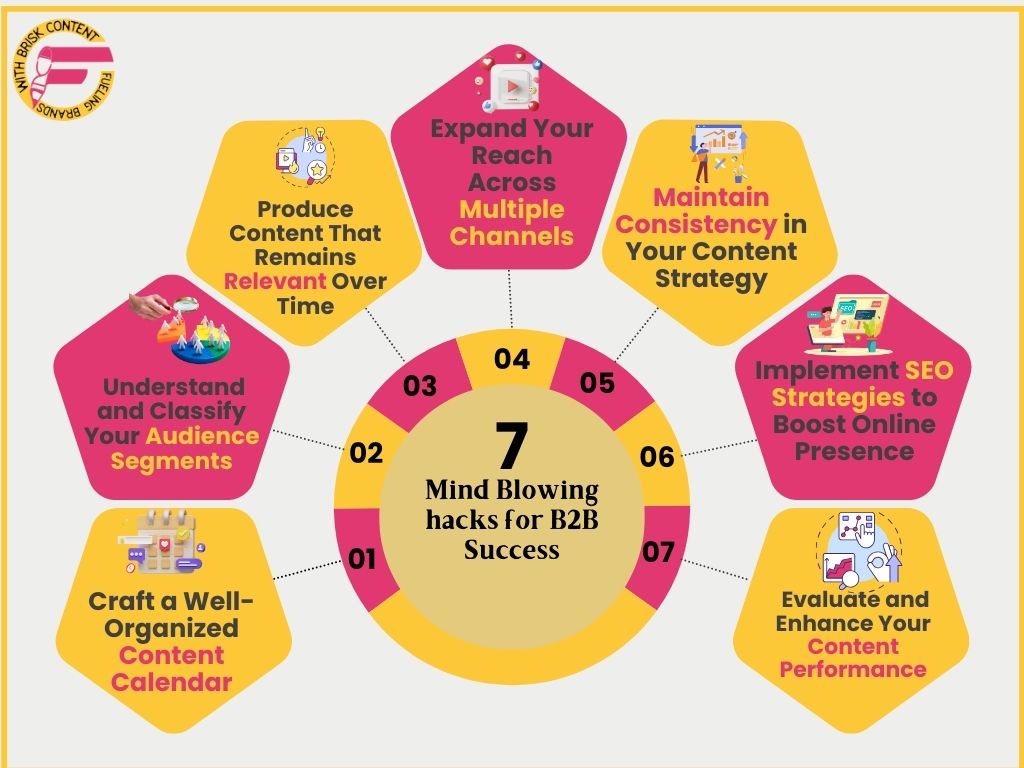
4. Expand Your Reach Across Multiple Channels
In today’s digital world, depending on a single platform for distribution can limit your reach and engagement potential. Expanding your reach across multiple channels is key to capturing a wider audience and maximizing the impact of your content marketing efforts.
Consider using blogs, videos, infographics, podcasts, and social media posts to effectively engage with different segments of your audience. Each platform has its own strength; for instance, video content may be best suited for social media, but in-depth articles are better for LinkedIn or industry blogs. This will increase the chances of engagement and sharing, depending on the platform’s specific style and audience preferences.
Furthermore, diversifying your reach allows you to experiment with different types of content and discover what resonates best with your audience. Ultimately, this multi-channel approach broadens your visibility and fosters deeper connections with potential clients.
5. Maintain Consistency in Your Content Strategy
Consistency is also a key to successful content marketing. Top-tier content published from time to time helps you achieve the audience’s trust and thereby positions your business as an expert in that sector. Whether it’s weekly blog updates or monthly webinars, maintaining such a schedule builds anticipation among viewers and provides them with fresh information regularly.
Maintaining consistency helps you stay at the forefront of consumers’ minds and boosts your website’s search engine results because search engines prefer sites that consistently add new content.
Maintaining a consistent voice and style for all channels helps strengthen brand identification and facilitates audience recognition and connection. Establishing rules for frequency, tone, and style that all team members can follow can help you achieve this level of consistency.
6. Implement SEO Strategies to Boost Online Presence
SEO is important for increasing the visibility of your B2B content online. By optimizing your content with relevant keywords and phrases your potential customers search for, you increase the likelihood of appearing higher in search engine results pages (SERPs). Begin by researching keywords to identify terms that align with your business goals and customer queries. Incorporate these keywords naturally into all content elements, including titles, headings, meta descriptions, and throughout the body text to improve its relevance to search engines without sacrificing user readability.
Technical aspects of SEO – including site speed and mobile-friendliness – can improve the user experience while making a ripple effect on rankings. Moreover, blogging older posts with new information or even different keywords can be relevant. If SEO is part of your content strategy, you can drive more organic traffic and position yourself as an authority within your niche.
7. Evaluate and Enhance Your Content Performance
Continuously evaluating and optimizing your content marketing efforts is the last hack to B2B success in 2025. Analytics tools let you track KPIs such as website traffic, engagement, conversions, and social shares. It helps you see which types of content resonate best with your audience and which need adjustment or improvement.
For instance, if certain topics generate higher engagement than others, consider creating more related content or exploring those themes further. Additionally, pay attention to user feedback through comments or surveys; this qualitative data can provide valuable insights into what audiences find most valuable or engaging about your offerings.
Optimization should be an ongoing process. Using analytics, you’ll experiment with distribution formats or channels to improve results. By committing to analysis and optimization, you ensure your B2B marketing strategy remains agile and responsive to changing market dynamics.
Conclusion
These seven hacks help you build a strong foundation for B2B content marketing in 2025. Tie strategies to business goals, understand audience pain points, and create evergreen content for lasting value. Diversify channels while staying consistent to boost reach and brand identity.
Regularly review metrics to refine what works, keeping you ahead in the digital landscape through planning, insights, longevity, and optimization.
If you’re ready to supercharge your B2B content with proven hacks that drive leads and growth, Content Fayah can help. Our experts deliver data-driven strategies tailored for success. Get started today for scalable results.
A content calendar is a planning tool that schedules topics, deadlines, and channels ahead of time. It aligns content with business goals, ensures consistency, and spots gaps for better engagement.
Evergreen content stays relevant long-term, driving ongoing traffic and leads. Optimize it with SEO keywords and update periodically to maintain authority and value.
Track KPIs like traffic, engagement, conversions, and shares using analytics tools. Use insights to optimize high-performers and refine underperformers for better ROI.