


7 Content Writing Tips to Boost Your Content Marketing
What makes one piece of content rank on Google while another gets buried? What makes one post go viral while thousands of similar ones are ignored?
The popularity of content marketing has led to a tsunami of content online. Millions of blogs, social media posts, videos, and articles are published every single day. The rise of AI has made producing content as easy as typing a search query. Anyone can now generate content in seconds.
But creating content that ranks and goes viral is far more than just putting words together. Content must be informative enough to educate, yet engaging enough to hold attention, and, of course, search-engine-optimized (SEO). It must read effortlessly, yet be compelling enough to keep the reader hooked till the last word.
Your content marketing strategy may be perfectly planned, but if the writing is weak, it will never deliver the results you’re aiming for. An outstanding strategy needs terrific writing to bring it to life
So, are you ready to supercharge your content marketing with exceptional writing? Here are the essential tips that will change the way you create content forever.
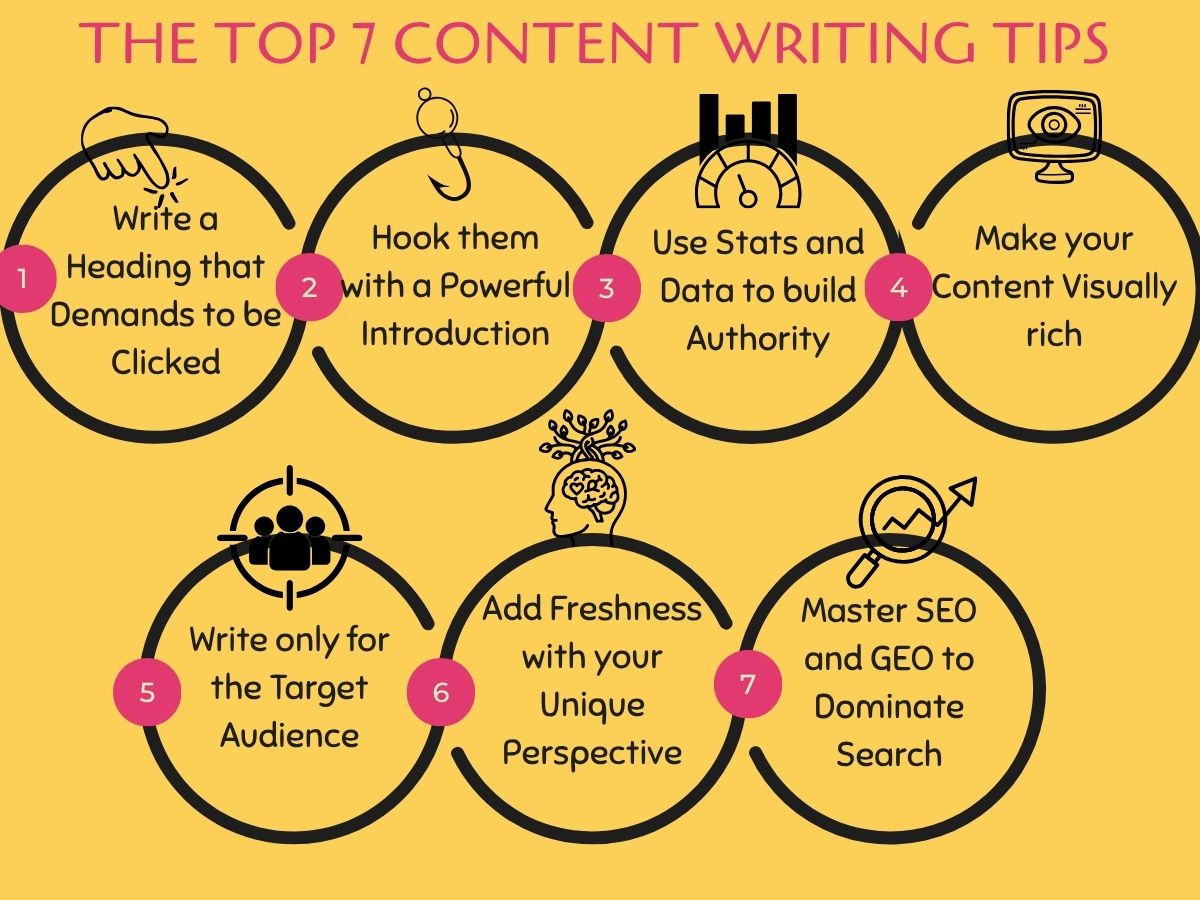
7 Tips to Transform Your Content Writing for Better Results
1) Write a Heading that Demands to be Clicked
Your headline is the most important line you will ever write for your content. It is the first thing the audience will read to decide whether to move on to your introduction or leave. In fact, according to Copyblogger, 8 out of 10 people will read a headline, but only 2 out of 10 will read the rest of the article.
A great headline not only grabs attention but also signals value and stirs curiosity. It should make readers feel they will gain something and that they have to continue reading, or they will miss out on something important.
Successful content creators, BuzzFeed and Cosmo, have built an entire media empire almost entirely on the strength of their headlines. Titles like “17 Things Only 90s Kids Will Understand” or “How to Get the Body You Want Without Going to the Gym” trigger an emotional response that makes clicking feel irresistible.
Another great example is HubSpot. Its blogs consistently rank on Google not just because of their content quality, but because their headlines reflect the search intent. Titles like “How to Write a Cover Letter That Gets You the Job” or “The Ultimate Guide to Email Marketing” tell you exactly what you’ll get while making you want it immediately.
So, make sure you spend enough time on curating a headline that ticks all the required boxes, such as:
- Clear and easy to understand (No cryptic word play)
- Use numbers, preferably odd ( 9 tips, 5 ways, 7 mistakes)
- Use words that people actually use (Search intent)
- SEO-friendly
- Keep it short
- Pair it with visuals (featured image or a thumbnail)
2) Hook them Early with a Powerful Introduction
A powerful introduction should hook the reader emotionally. Its first couple of sentences should address a pain point with a powerful question or a shocking stat. It should then aim to establish the relevance of the topic to their life and promise a solution worth reading.
It should never begin with a dictionary definition or a generic statement like “In today’s world…” — these are the fastest ways to lose a reader who was already curious enough to click.
James Clear, author of the globally bestselling book Atomic Habits and one of the most subscribed newsletter writers in the world, almost always opens with a single short, punchy sentence or a surprising fact that stops you cold. His blog post on habits opens with — “Every action you take is a vote for the type of person you wish to become.” One sentence. Entire attention captured.
Your introduction also has a critical technical job to do. To rank with google it must contain your primary SEO keyword, ideally within the first 100 words. Google scans the opening lines of your content for SEO keywords to determine its relevance to a search query. By adding keywords naturally in the introduction, you can ensure your content ranks for a particular search query.
Here are the most effective techniques for writing an introduction that hooks:
- Open with a surprising fact or powerful question ( address pain point)
- Start with a bold statement (challenges commonly held beliefs)
- Establish emotional connection
- Use SEO keywords naturally
- Promise value
3) Use Stats and Data to build Authority
Research by Demand Gen Report found that 96% of B2B buyers want content with greater input from industry thought leaders. When you cite credible research, you position yourself not just as a writer but as an authority. You become a source worth trusting, referencing, and returning to.
Content Marketing Institute publishes an annual report packed with industry data that is referenced by marketers globally every single year. Neil Patel regularly publishes data-backed case studies on his blog — articles like “I Analysed 1 Million Headlines — Here’s What I Learned” routinely generate hundreds of thousands of visits because they offer something genuinely unique.
Google rewards well-researched, cited content with higher rankings. AI engines like ChatGPT and Perplexity actively draw on and credit content that includes verifiable statistics. In the new era of search, your data is your visibility.
Follow these rules when using data in your content:
- Use data to open loops — a shocking figure makes readers curious for the explanation
- Cross-check your statistics — verify the same figure across multiple sources before citing
- Prefer primary sources — link directly to the original report, not a blog that quoted it
- Keep data current — aim for statistics from the last two to three years maximum
4) Make your Content Visually Rich
According to John Medina, molecular biologist and author of Brain Rules, people retain 65% of information when it is paired with a relevant visual — compared to just 10% retention from text alone.
A relevant image or graphic placed at the right moment breaks the monotony of continuous text and makes the overall content feel more inviting and easier to digest. The result is a reader who stays longer and absorbs more.
The infographic presents the information in a concise and visually engaging format. Complex processes, step-by-step guides, and comparative information that would take hundreds of words to explain in text can be communicated in seconds through a single well-crafted infographic.
Statistics can be presented as a bar chart, a pie chart or other data visualization graphics, which the brain processes instantly and remembers.
From an SEO perspective, visuals matter more than most writers realize. Properly optimized images with descriptive file names, compressed file sizes and keyword-rich alt text can drive significant traffic through Google Image Search. Infographics in particular are among the most linked-to content formats on the internet, earning backlinks that strengthen your domain authority.
Here is a practical guide to choosing the right visual for your content:
- Infographics — ideal for presenting processes and comparisons
- Custom charts and graphs — perfect to represent data and statistics
- Photos and illustrations — visually pleasing images to build an emotional connection or break up long text sections
- Videos and GIFs — highly effective for demonstrations and tutorials
5) Write only for the Target Audience
Knowing your audience is the foundation for everything else. The tone you adopt, the examples you choose, the problems you address, and the solutions you offer must be shaped by a deep understanding of who you are writing for.
Audience research also directly strengthens your SEO strategy. The keywords your audience uses when searching for solutions to their problems are the exact keywords your content should be built around. Understanding your audience’s language, their questions and their pain points is the most effective form of keyword research.
Here are the most effective ways to research and understand your audience:
- Google Analytics — reveals who is visiting your content and what they read
- Social media insights — Facebook, Instagram and LinkedIn provide behavioral data (tone, language)
- keyword research tools — Google Keyword Planner, Ahrefs and SEMrush show exactly what your audience is searching
- Surveys and questionnaires — ask your existing audience directly what content they want
- Online communities — Reddit, Quora and niche Facebook groups reveal the pain points
- Competitor analysis — study which content your competitors publish that performs best and why
6) Add Freshness with your Unique Perspective
In an era where AI can produce technically flawless content in seconds, your humanity is your most valuable differentiator. Adding a personal touch is about allowing your genuine voice, values and perspective to come through in everything you write. It is the difference between content that informs and content that connects. Connection is what turns a casual reader into a loyal follower and, eventually, a paying customer.
When your audience catches a glimpse of the real person or people behind a brand, it creates a sense of familiarity that no amount of professional copywriting can manufacture.
Neil Patel built a multi-million-dollar digital marketing empire largely on the back of transparent, personal content — openly sharing his own failures, revenue figures, mistakes and lessons. His readers trust him not because he is perfect but because he is honest.
Here are the most effective ways to add a personal touch to your content:
- Share your own experiences and stories — real examples of both failures and successes
- Express genuine opinions — do not be afraid to take a position on industry debates
- Show behind the scenes — give readers a glimpse into your working process
- Use conversational language — write the way you speak
- Use your name and face — dramatically increases readers’ trust and content credibility
7) Master SEO and GEO to Dominate Search
At its core, Search Engine Optimization (SEO) in content writing means understanding what your audience is actively searching for and crafting content that answers those searches. For years, SEO meant researching your keywords and placing them strategically to improve ranking. But the rise of Artificial Intelligence has fundamentally changed how search engines evaluate and rank content. The content writers who are still playing by the old rules are falling behind.
Today’s search engines are powered by AI tools like ChatGPT Search, Perplexity and Microsoft Copilot. These tools do not simply scan content for keywords. They read, evaluate and, assess it against a sophisticated set of criteria that goes far beyond keyword frequency.
This evolution has given rise to an entirely new discipline called Generative Engine Optimization (GEO). As AI-powered search tools become the primary way millions of people find information online, optimizing your content to be discovered, cited and referenced by these AI engines is rapidly becoming as important as traditional SEO.
AI search tools do not just rank content, they synthesize it and present parts of the content that exactly answer the point. Content that is well-structured, rich in original data, and properly cited is likely to be selected by AI engines as a trusted source.
Here is how to optimize your content for both SEO and GEO:
- Write with genuine expertise
- Structure content clearly
- Match search intent precisely
- Cite credible sources
- Cover topics comprehensively
- Keep content updated
A Word About Artificial Intelligence AI
No conversation about content writing in 2026 is complete without addressing Artificial Intelligence. Used intelligently, AI can make you a significantly more productive writer.
As a research and ideation tool, AI is extraordinary. It can brainstorm topic ideas, generate multiple angles, suggest relevant statistics, create content outlines and help you overcome the paralyzing blank page that every writer knows too well. Some of the best AI tools for content writers include Jasper, Claude and Surfer SEO.
However, AI-generated content comes with serious limitations. The AI content is generic, repetitive and oddly formal. More seriously, AI can generate incorrect information, presenting fabricated statistics and non existent citations with complete confidence. To learn more about drawbacks of using AI unchecked, read our blog ‘Potential Pitfalls of Using AI for Marketing.’
The bottom line is that AI is like your 24-hour assistant who is brilliant, tireless and enormously useful. But you are the boss. And on any topic that truly matters, your insight and humanity will always produce better content than any machine ever could.
Here is how to use AI smartly:
- Use it for content ideation and outlining
- Verify every statistic independently
- Never publish unedited AI content
- Add your human layer
BOTTOM LINE
The fact that Content Marketing delivers real results has been proven time and again by various studies. Companies have significantly boosted their ROI by leveraging the power of content marketing.
The key to successful content marketing is well-written, unique and impactful content. One must understand that writing for digital marketing is different from traditional marketing. In the digital world, your piece has to work hard to be visible in the sea of content. Content marketing may be cheaper than traditional marketing, but it requires a talented workforce with certain skills to do it effectively.
The bottom line is that business owners need to take an active approach to their content writing to get better results from their content marketing efforts. By following the guidelines stated above, you can ultimately transform your content with ease from ‘ok’ to ‘awesome’, and your content marketing can reach a wider audience and increase engagement.
FAQ’s
Content writing the actual process of researching, drafting and polishing written material such as blogs, social media posts, newsletters and website copy. Content marketing is the strategy that determines what content is created, for whom, through which channels and towards what business goal.
There is no universally perfect length for blogs. The key principle is that your content should be exactly as long as it needs to be to answer the reader’s question comprehensively and authoritatively. Focus on depth and relevance over word count.
AI-assisted content will not automatically hurt your Google ranking. Google’s official position is that it does not penalize AI-generated content simply for being AI-generated. What Google does penalize is content that is low quality, unhelpful, unoriginal or clearly produced without genuine human expertise.
The practical implication for content writers is to use AI as a powerful assistant for research, ideation, outlining and first drafts, but always bring your own expertise, voice, verified data and personal perspective to the final content.