

What is Bottom-of-the-Funnel Content and How to Create it?
Starting your journey to boost sales means focusing on what really works when buyers are ready to commit. Bottom-of-the-Funnel (BoFu) content does exactly that—it gives your prospects the confidence and proof they need to choose your product over others.
Companies like Reloadly have increased sales by giving buyers clear product demos, interesting case studies, and simple price pages that stick in their minds. Another smart tactic is showing customer testimonials or hosting webinars to address last-minute questions. This kind of content doesn’t just inform; it helps buyers see real value and removes doubts, pushing them to take action confidently.
What Is Bottom-of-the-Funnel Content?
Bottom of the Funnel (BoFu) is the final stage in the buyer’s journey where potential customers are ready to make a purchase decision. At this point, they have already researched their options, compared different brands or products, and are now deciding which one to choose.
BoFu content and marketing concentrate on helping these prospects take the last step to become paying customers by giving information that builds trust and shows clear value, such as demos, consultations, case studies, or customer testimonials. Essentially, it’s about turning interested leads into buyers by answering their final questions and making the buying process easy and convincing.
Why Is Bottom-of-the-Funnel Content Important?
Bottom-of-the-Funnel (BoFu) content is important because it targets people who are ready to buy, helping you turn visits into real sales and grow your business faster.
1. Different Content, Different Buyer Intent
- BoFu content targets buyers who are ready to make a purchase decision.
- Unlike general content that attracts curious visitors, BoFu content helps people who are comparing options and are serious about buying.
2. Quality Over Quantity
- BoFu content may get less traffic, but it attracts high-quality visitors with clear buying intent.
- It focuses on converting these visitors into customers, which is more valuable than just increasing overall pageviews.
3. Higher Conversion Rates
- BoFu content converts at much higher rates — up to 10 times more than top-of-the-funnel content.
- This means more of your website visitors become paying customers.
4. Bigger and More Valuable Deals
- Sales coming from BoFu content tend to be larger and more profitable.
- For example, comparison posts (a common BoFu content type) often bring in not just more customers but also bigger deals.
5. Focus on Business Results
- Investing in BoFu content first helps you get real business results much faster.
- It ensures you’re creating content that actually drives sales and revenue, rather than just traffic.
6. Boosts Confidence and Removes Doubts
- BoFu content answers final questions, provides proof like case studies or demos, and helps buyers feel confident in their decision.
Differences Between Top, Middle, and Bottom-of-the-Funnel Content
Let’s understand the difference between the three stages of the content marketing funnel:
- At the Top of the Funnel (ToFu), your goal is to grab people’s attention. This is where they first hear about your brand and realize they might have a problem. The content here is simple and broad, designed to educate or entertain, like blog posts or social media updates.
- Moving to the Middle of the Funnel (MoFu), people know their problem and start looking for solutions. They compare options and want to know how your product or service can help. Content here dives deeper with guides, webinars, and case studies to build trust.
- Finally, at the Bottom of the Funnel (BoFu), people are ready to buy. They need clear reasons to pick your product and proof that it works. BoFu content includes product demos, free trials, pricing details, and customer reviews to help them make the final decision.
Types of Bottom-of-the-Funnel Content That Converts
Here are some types of Bottom-of-the-Funnel content that really help you convert visitors into customers:
- Case Studies — These tell real stories about how your product helped someone solve a problem. They show proof that your product works and can give your visitors confidence to buy.
- Product Demos — Videos or tutorials that show your product in action. When people see how easy or useful something is, they feel more sure about choosing it.
- Customer Testimonials and Reviews — Hearing from happy customers builds trust. It’s like a friend recommending something—it makes your product feel more reliable.
- Comparison Posts — When people are deciding between options, comparison articles or pages help them see why your product is the best choice.
- Pricing Pages — Clear, simple info about costs and plans helps buyers decide quickly without confusion.
- Free Trials or Consultations — Letting people try your product or talk to you without risk gives them a nudge to commit.
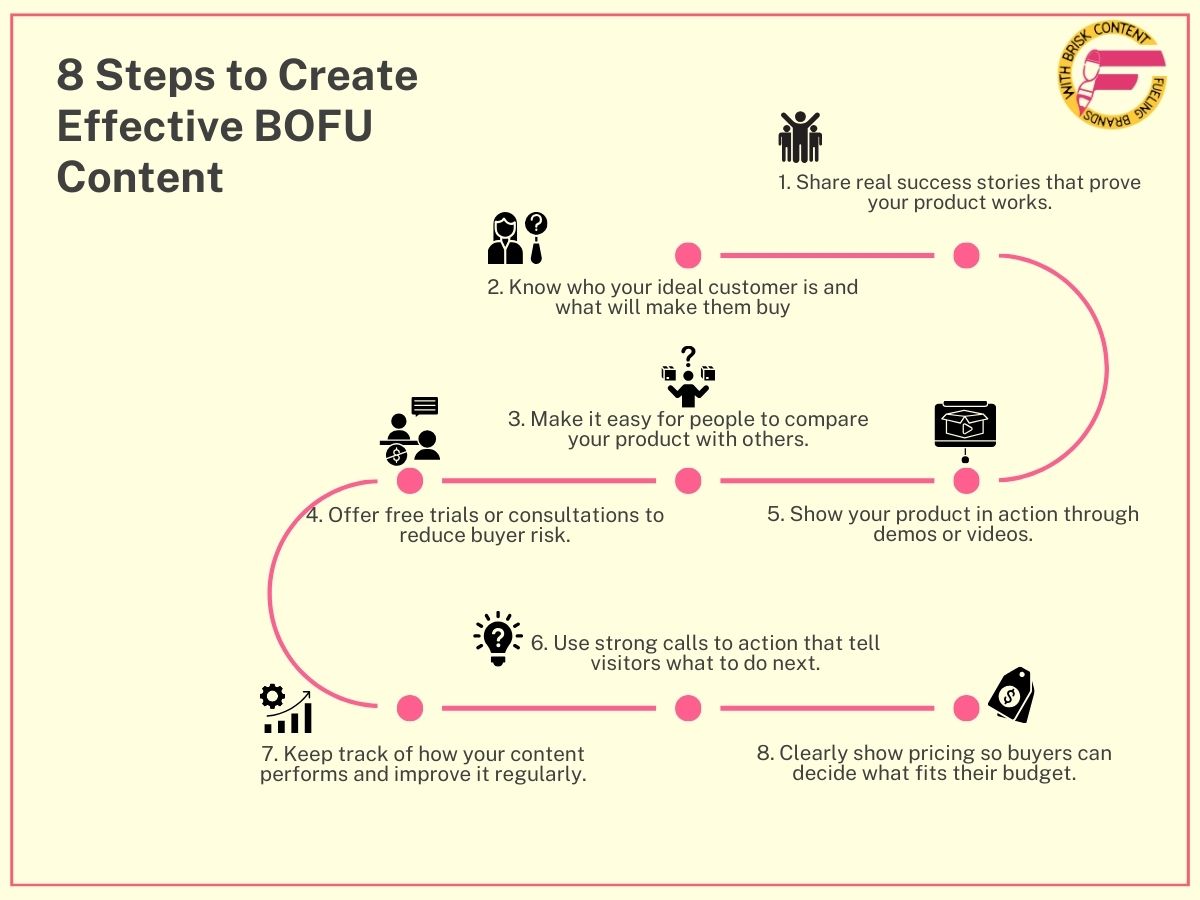
How to Create Effective BOFU Content: Step-by-Step Guide
Here’s a simple step-by-step guide to help you create effective Bottom-of-the-Funnel (BoFu) content:
- Know who your ideal customer is and what will make them buy.
- Share real success stories that prove your product works.
- Show your product in action through demos or videos.
- Make it easy for people to compare your product with others.
- Clearly show pricing so buyers can decide what fits their budget.
- Offer free trials or consultations to reduce buyer risk.
- Use strong calls to action that tell visitors what to do next.
- Keep track of how your content performs and improve it regularly.
This simple approach will help you create BoFu content that converts visitors into customers.
Best Practices for BOFU Content Creation
- Focus on One Buyer at a Time
Make your content for a specific type of buyer who is ready to make a decision. Use keywords that show they want to buy, not just browse. - Be Clear and Direct
Tell your readers exactly what to do next—like “Start Your Free Trial” or “Request a Demo.” Focus on your product and how it helps, but always keep it helpful. - Build Trust
Use real customer reviews, testimonials, and success stories to show others have had a good experience. Share awards or credentials that prove you’re reliable. - Write Persuasive and Helpful Copy
Explain how your product benefits the buyer, not just what it does. Create urgency by mentioning special deals or limited stock. Answer common doubts right away. - Make It Easy to Find and Enjoy
Use strong images and videos to keep people interested. Optimize your content in a way that it shows up in search engines when buyers look for last-minute info. Keep your content updated with fresh examples.
Measuring the Success of Your BOFU Content
Measuring the success of your Bottom-of-the-Funnel (BoFu) content means looking at how well it helps turn interested leads into paying customers. You want to focus on key signs like conversion rates — how many people sign up for free trials, request demos, or make purchases.
Also, check the ratio of leads turning into customers and the revenue your BoFu campaigns bring in. Other useful measures include tracking assisted conversions, spotting where people drop out of your sales funnel, and collecting direct feedback to see how your content influences the final buying decision. This way, you’ll know exactly how your content is performing and where to improve for better results.
Examples of Effective BOFU Content
Effective BoFu content includes comparison pages that help buyers see how your product stacks up against others, and case studies that share real success stories from customers. Product demos and testimonials build trust by showing your product in action and with happy users. Free trials let buyers test your product risk-free, while clear pricing pages make it easy for them to understand costs. Other great examples are personalized sales calls, webinars, and “best of” or “alternative” product lists that guide prospects in choosing the right fit.
Common Mistakes to Avoid in BOFU Content Creation
Avoid these common mistakes to make your Bottom-of-the-Funnel content clear, trustworthy, and effective at turning visitors into customers.
- Buyer confusion: Not clearly understanding who your buyer is and what they need.
- Weak messaging: Being unclear or hesitant in your sales approach.
- Missing CTAs: Not telling people what step to take next.
- No trust builders: Leaving out testimonials or proof that your product works.
- Too much info: Overwhelming buyers with unnecessary details.
- Poor SEO/user experience: Making it hard to find or use your content.
- Lack of teamwork: Not involving sales or product teams to cover buyer questions.
Conclusion
Bottom-of-the-Funnel (BoFu) content helps ready-to-buy customers confidently choose your product by providing clear proof, demos, and testimonials that remove final doubts. It’s about guiding buyers smoothly to “yes” with case studies, pricing clarity, and risk-free trials.
Ready to create high-converting BoFu content that closes sales? Content Fayah specializes in funnel-optimized content that turns prospects into customers. From case studies to demo videos, our experts craft BoFu strategies that deliver ROI. Get started today for content that converts.
BoFu content targets ready-to-buy prospects with case studies, demos, testimonials, pricing, and free trials. It builds trust and removes final doubts to convert visitors into customers.
ToFu attracts and educates, MoFu nurtures with solutions, BoFu closes sales with proof like demos and testimonials. Each stage matches a different buyer intent for maximum conversion.
Case studies, product demos, customer testimonials, comparison pages, clear pricing, and free trials work best. They provide social proof and reduce buyer risk effectively.