


Web Content Writing for Businesses: Do’s and Don’ts
Your website’s content can make or break your brand’s reputation. You may get a visitor to land on your page, but will they stay? Will they act? That depends on how well your content speaks to them.
While boring or jargon-filled lines drive you away, interesting, simple-to-understand content keeps you interested. Your website can stand out in the highly competitive Indian digital market, where users have short attention spans and sharp content is essential. Without sacrificing creativity or quality, let’s get into the fundamental dos and don’ts of content writing for websites.
Why Quality Content Matters
The content of your website serves as your digital greeting. Well-written content reflects your professionalism, increases search engine exposure, and helps you draw in, hold on to, and convert visitors. Conversely, poor content undermines confidence and causes users to quickly abandon a website.
Dos of Content Writing
- Do: Know Your Audience First
Before typing a single word, ask: Who is reading this?
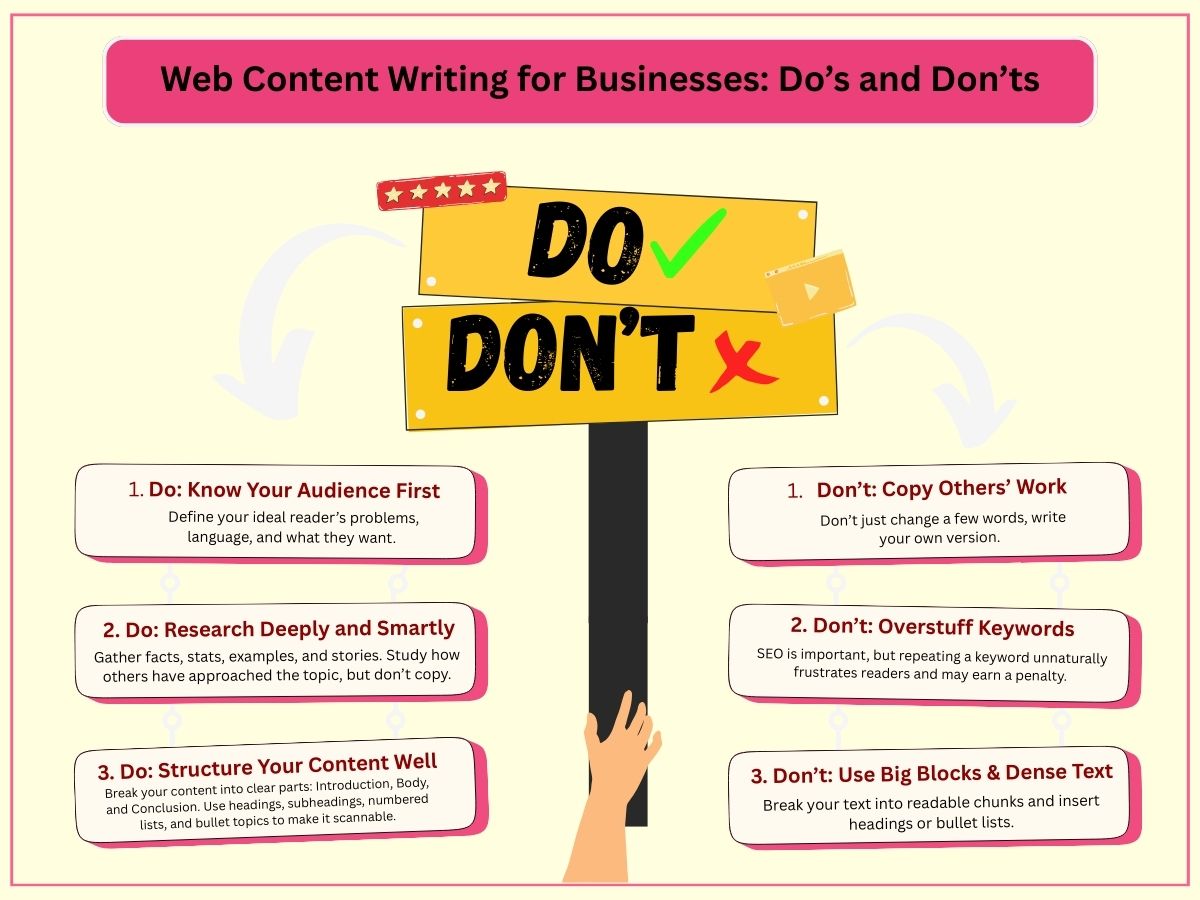
Define your ideal reader’s problems, language, and what they want. Use those cues in your writing. Make them the hero of your story, not you.
Good copy connects with readers’ needs. Use “you,” address their pain, and show how your content or product solves it.
- Do: Research Deeply and Smartly
Strong content starts with solid research. Gather facts, stats, examples, and stories. Study how others have approached the topic, but don’t copy them.
Also, research SEO: your keywords, search volume, and related terms. Weave them naturally, not forcefully.
- Do: Structure Your Content Well
Break your content into clear parts: Introduction, Body, and Conclusion. Use headings, subheadings, numbered lists, and bullet topics to make it scannable.
Short paragraphs (one to three sentences) help readers flow smoothly. Avoid giant blocks of text.
Begin with a hook: a story, a question, a bold fact, or a scenario. Grab attention in the first few lines.
- Do: Use Active Voice, Simple Language
Active voice makes your writing direct and powerful: “You will get results,” not “Results will be obtained by you.” Even MyTasker recommends this for e-commerce content.
mytasker.com
Avoid big, fancy words or jargon. Write like you talk, with clarity.
- Do: Focus on Value, Not Fluff
Your readers are busy. Give them something useful, tips, solutions, insight. Don’t stuff your content with fluff or vague statements to increase word count.
Link to credible external sources, and also within your site. That helps readers dig deeper and boosts your SEO.
- Do: Edit, Proofread, Revise
Millions of errors lurk in drafts. Always recheck your content after writing. Read it aloud. Use grammar tools. Get a fresh pair of eyes to review.
Take a break before final editing. Fresh eyes spot missing pieces.
Don’ts of Content Writing
- Don’t: Copy Others’ Work
Plagiarism ruins credibility and SEO. Don’t just change a few words; write your own version.
Even meta descriptions or similar phrases can get flagged.
- Don’t: Overstuff Keywords
SEO is important, but repeating a keyword unnaturally frustrates readers and may earn a penalty.
Use keyword variations and synonyms to keep it natural.
- Don’t: Use Big Blocks & Dense Text
Long paragraphs discourage reading. Use white space wisely.
Break your text into readable chunks and insert headings or bullet lists.
- Don’t: Talk Too Much About Yourself
Your content should not be all about “we” or “our brand.” Make the reader the focus. Show how you help them.
Even in “About Us” pages, talk benefits first, then your story.
- Don’t: Ignore Design & Readability
Good writing gets ruined if it’s crammed in a bad layout or unclear format.
Use headings, text size, spacing, and visuals to support your content.
- Don’t: Rush to Publish Immediately
It’s unusual that your first draft is flawless. Let it rest. Come back with new insights. Grammar, tone, and flow in Polish.
Test several headlines or calls to action to determine which ones perform better.
Here’s how you can string these dos and don’ts into a flow:
- Start with a hook: “Imagine someone landing on your blog—but leaving in 5 seconds.”
- Address the reader: “You want to keep people on your page. Let me show you how.”
- Show structure: Use headings like “Research → Write → Edit.”
- Give value under each heading: short tips, examples, dos and don’ts
- Weave in a mini case or stat to strengthen your point
- End with a call to action: “Try these tips in your next post. See the difference.”
Final Thoughts
Being straightforward, relatable, and helpful is more important when writing for the web than being creative. A well-written post has the power to convert visitors into clients, supporters, or devoted readers.
To achieve that, keep the balance between creativity and strategy. Research deeply, write with purpose, edit ruthlessly, and respect your audience’s time.
When your words reflect honesty, clarity, and understanding, they build trust. Trust leads to engagement, and engagement brings growth.
The best content doesn’t sound like marketing; it sounds like conversation. So write as if you’re talking to one person who truly matters. That’s when your content begins to work. That’s exactly whatContentFayah delivers through expert web content writing. Schedule your free strategy session today and transform your website copy into conversations that convert.
FAQs
Know your audience first, research deeply with SEO keywords, structure content for scannability using headings and short paragraphs, and focus on delivering real value through actionable insights.
Don’t copy others’ work or overstuff keywords, avoid dense text blocks and excessive “we” language, and never rush publishing without thorough editing and proofreading.
Research thoroughly for credibility, write conversationally with active voice and simple language, edit ruthlessly for clarity, and always prioritize reader benefits over brand promotion.