
How to Plan Your AI Content Strategy?
Effective content marketing starts with an exceptional content strategy. An efficiently planned content marketing strategy will boost your search traffic and increase the number of valuable actions your audience takes.
As Artificial Intelligence (AI) transforms how we work, think and create, why not use it to supercharge your content strategy, too? In this post, we will discuss how to plan and build your AI content strategy using the latest AI tools, making the complete process smarter, faster and more impactful.
What is a content strategy?
A content strategy outlines how your business develops, publishes and manages its online content to achieve clear objectives. It acts as a roadmap to guide your efforts in delivering targeted, valuable, and consistent digital material across different platforms.
The essential components of a reliable content strategy include:
- Ideas for valuable content: Testimonials, video tutorials, Interviews, research, FAQ’s
- Type of content: Blogpost, videos, podcast, infographics, whitepapers, etc.
- Distribution Platform: Website, emails, social media, etc.
- Resources: Workforce, time, and budget.
- Publishing deadline: A Structured calendar to ensure a consistent publishing
Why is it Necessary for Marketers to create a Content Marketing Strategy?
A strong content strategy will better equip you to create convincing narratives and rich content experiences that inform, engage and inspire. Without a structured approach, your efforts risk being inconsistent and ineffective.
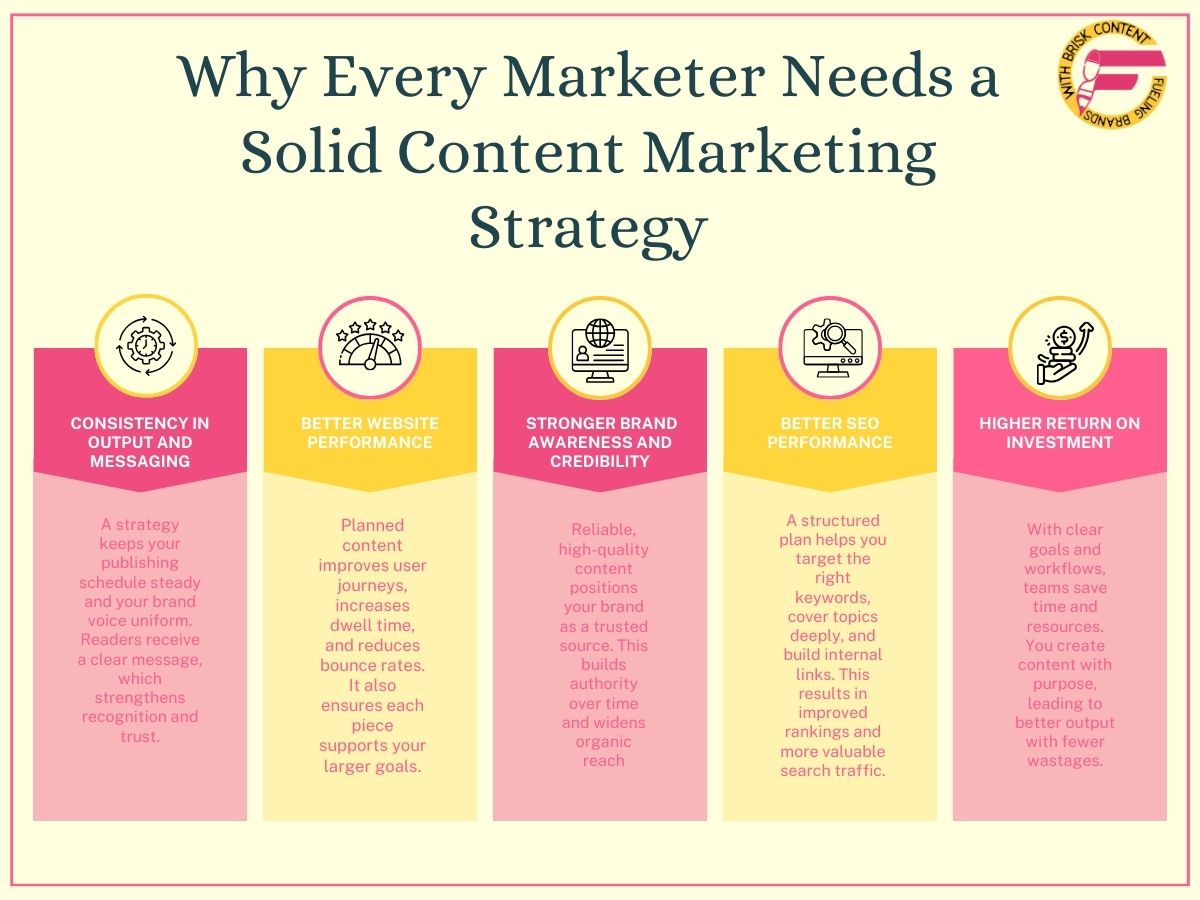
A well-defined content marketing strategy provides several long-term benefits:
- Consistency in output and brand message.
- Better website performance
- Improved brand awareness, credibility, and trust.
- Enhanced SEO performance and valuable search traffic.
- A better return on investment through optimized content creation processes.
- Helps in goal setting and Tracking
- Lower operational costs by avoiding redundant efforts.
Charging up your Content Marketing Strategy with AI
AI is reshaping the content marketing landscape at a rapid pace. According to recent AI content marketing statistics
- 67% of marketers use AI for content marketing or SEO
- Marketers who use AI see an average of 70% increase in ROI
Using AI for content marketing leverages machine learning algorithms to automate and optimize your content-related processes. It will improve your audience targeting, discover new content opportunities, and enhance engagement through better personalization. By adopting AI tools, you can focus on high-value creative work while AI handles data-intensive tasks such as research, keyword analysis, and performance tracking.
Content Marketing Strategy Statistics
“At this moment, AI is changing the game for marketers. If you are not adopting AI in your day-to-day process, the risk of falling behind your competitors is greater and greater.” Dan Sheffer, Director, SEO.com
Below is the list highlighting the growth of AI in marketing
- In 2025, AI in the marketing industry is worth $47.32 billion, up from $12.05 billion in 2020.
- International AI marketing revenue is estimated to reach 107.5 billion dollars by 2028
- The AI marketing industry is expected to grow at a compound annual growth rate of 36.6% globally between 2024 and 2030.
Elements of a Content Strategy Plan Powered by AI
The stages of an AI content marketing strategy include content ideation, creation, distribution, and performance measurement. Let’s see how AI content creation tools support each stage of content planning:
1. Brainstorming:
The first step to creating a plan is generating ideas. There are powerful AI tools designed to generate new viewpoints and connections, resulting in more diverse and innovative content ideas. Miro AI Assist, Notion AI, and Otter are great brainstorming tools you can use.
2. Research and Data Analysis
Great marketers are also great researchers. Effective content relies on an in-depth understanding of both the audience and competitors. Elicit, Research Rabbit, and Consensus are AI tools that simplify this process by consolidating insights from multiple credible sources, summarizing findings, and identifying key trends. This will help you make quicker, data-backed decisions and identify content gaps.
4. Text-Based Content Creation
AI’s text generation tools, such as ChatGPT, Google’s Gemini, Claude, and Copy.ai, help you quickly draft blog posts, ad copy, and emails. Want the top SEO content writing tools that work with AI? Check out our blog on the best SEO content writing software for 2026 to discover AI-powered tools that make content creation faster and more effective.
5. Automated Conversational Marketing
AI chatbots have become an integral part of conversational marketing, enabling personalized engagement. Platforms like Drift, Slack integrations, and ManyChat help automate interactions and provide instant support. These systems operate 24/7, ensuring your brand remains approachable at any hour and leading to higher conversion rates.
6. Multimedia Content Creation
Multimedia generation powered by AI is experiencing rapid growth. Tools like Synthesia, Pictory, and Runway ML enable the quick creation of videos, graphics, and infographics. For instance, you can repurpose a current blog post into a video to enhance engagement on social platforms.
7. Performance Tracking
AI tools for content marketing performance measurement analyze large amounts of data to provide actionable insights, track key metrics, and optimize future strategies. HubSpot’s Marketing Hub and SEMrush are examples of such platforms that help you track how content impacts the sales pipeline and revenue.
Limitations of AI in Content Planning
While the potential of AI content creation tools is extensive, they still have limitations. One must remain watchful as AI can lack context, creativity, and emotional intelligence.
Some common challenges include:
- Data Quality: AI-generated content relies on patterns found in existing data, which can sometimes be outdated or inaccurate. Human verification is essential before publishing information online.
- Data Security: AI is currently unregulated, so there is no guarantee your shared information won’t be stored or shared with others.
- Over-Automation: Relying entirely on AI can lead to generic and impersonal content that fails to connect emotionally.
Conclusion
AI may be used to conduct various types of research and identify interesting angles, but it can never fully replace writers and thinkers. Humans’ touch in content strategy will always require critical thinking. AI can assist you by producing content in a shorter time, but you will need the services of humans to feed in the right prompt. Combining these tools with Human creativity and careful thinking is the best way to use them.
Content marketers like Content Fayah can help you by adding that essential human touch, ensuring creativity and credibility are maintained. The expertise to seamlessly combine AI with human creativity allows you to connect with your audience on an emotional level and build strong customer relationships, which are paramount to a successful marketing campaign.
An AI content strategy uses tools like ChatGPT and Gemini to plan, create, and optimize content faster while preserving human creativity to drive better engagement and ROI.
Miro AI Assist, Notion AI, and Otter generate diverse content ideas quickly, helping you brainstorm innovative topics and angles for blogs, videos, and social posts.
AI lacks emotional intelligence and context, so human oversight is needed to ensure authenticity, data accuracy, and brand voice in final content.