
White Paper vs. eBook: Which is the better format?
Thousands of research studies and statistics indicate that short‑form content, such as Instagram Reels, TikTok videos and quick-hit podcasts, achieves the highest viewership and engagement. And more often, you as content marketers fall into the trap of believing that content with the most views is the “winner.” But is it really?
Let’s think about it this way: Why did you create the content in the first place? What was your primary goal? If the answer is, “To get the highest views and comments,” then an engrossing short-form content will achieve that objective. But if your answer is “To generate leads and drive conversions,” then according to the research, short‑form alone will definitely fall short.
Short-form content may go viral quickly, but it loses the race when it comes to generating meaningful leads. An expert analysis by MarketingLTB shows that long‑form guides lift email opt‑in rates by 54%, and long‑form landing pages can boost conversions by 20–60%. In fact, 72% of marketers report that long‑form content generates more qualified leads than short‑form content.
So, when it comes to lead generation, long‑form content is the clear winner.
This blog explores two important long‑form formats, whitepapers and e-books, to determine which is best for your content marketing strategy. We’ll compare them across key metrics and help you decide which one should become an indispensable part of your content marketing strategy.
What is a Whitepaper?
White papers are in-depth, authoritative pieces of content in which the author identifies a problem and presents a detailed, research-backed solution. It is text-dense and loaded with accurate data to prove the author’s point of view.
An example of a high-quality white paper is ‘Global Cybersecurity Forum 2025’, a strategic white paper published by the World Economic Forum (WEF) in affiliation with Accenture, a cybersecurity solutions provider. It reflects Accenture’s expertise in cybersecurity and shows how the company is ready with solutions to address the cyber threats the world will face in the future due to AI.
What is an ebook?
An ebook, or Electronic book, is not as deep or scholarly as a whitepaper. It is easier to read and understand than a white paper. Along with text, it also includes images and videos to provide a more engaging experience for readers. Instead of providing a single solution, it offers an overall view of an issue, comparing and contrasting the features of many available solutions.
ProductSchool is an online education platform for product managers and designers. Their dedication to publishing helpful ebooks has made them leaders in online education.
Now that we understand what both whitepapers and ebooks are, let’s look at how they differ in purpose, audience, and format. Then we decide which format deserves a place in your content strategy.
What Purpose Does Each Serve?
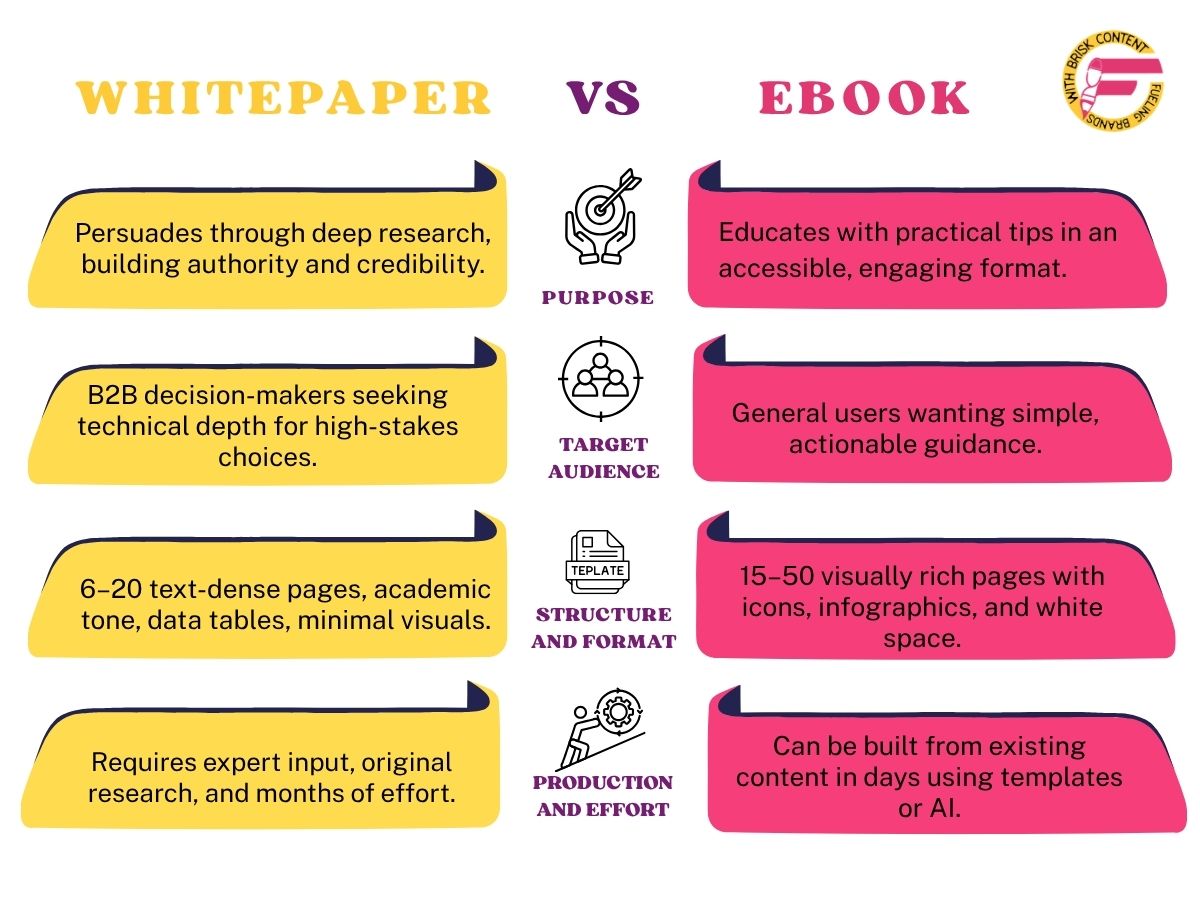
Whitepapers: The primary intent is to present detailed information on a selected topic and to persuade the audience by building credibility and authority. The selected topic usually addresses a unique solution to a specific problem your industry is facing or will face. It is also used to build Thought Leadership.
A high-quality whitepaper delivers in-depth information backed by well-researched data and thorough analysis. It is authored by a team with high-level expertise in their field, for an audience actively seeking solutions. The ultimate goal is to build enough credibility that your potential customer trusts you as the best solution provider.
For instance, if you make medical devices, you might publish a white paper on clinical research to build credibility. Or if you are in the renewable energy field, a white paper on the long-term cost benefits of switching to solar could help you target large corporations and government tenders.
ebooks: On the other hand, the purpose of an ebook is to educate and provide practical tips that are easy to comprehend and apply.
You can publish ebooks to introduce or explain complex concepts and connect with them in the process. It uses images and videos to make the information more digestible and engaging. The ultimate purpose is still to generate leads by providing value, while keeping it simple and visually engaging.
For instance, if you run a health food brand, you could publish an ebook on ‘Easy meal prepping for busy professionals’.
Who is the Target Audience?
Whitepapers: Written for high-level professionals and decision-makers, these detailed documents address the technical details they seek. Since they are responsible for making high-stakes decisions, the whitepapers provide them with in-depth information. The whitepaper format is therefore primarily used as a B2B marketing tool.
Ebooks: Written mainly for the end user who is not really concerned with the complex technical details. The target customers just want to learn enough about the topic to help them with a task or day-to-day decisions. The easy-to-understand format, along with engaging visual content, makes the ebook the format of choice for companies looking to connect with a new audience.
For instance, a Chief Technology Officer at a million-dollar company would refer to a vendor’s white paper to assess the vendor’s authority and expertise. But a small-business owner, a first-time user seeking digital security for his business, will prefer an easy-to-understand cybersecurity ebook.
Format and Structure
Whitepaper: a lengthy piece of content, ranging from around 6 to 20 pages. It is filled with text, research citations and data tables. It uses minimal colors. In its structure, it is similar to an academic writing or a case study.
Ebook – Ebooks typically have 15 to 50 pages, but the textual information on each page is comparatively very little. They are formatted to look visually appealing. They are dotted with icons, pull quotes, infographics, and videos. Intentional white spaces are inserted to make it easier to skim and read.
Production and Effort Cost
Whitepaper: Because your white papers must be in-depth and accurate, they require extensive original research and analysis, fact-checking, and, in some cases, legal review. The whole process may take months and is costly to produce, as it requires input from experts in the field. Therefore, most whitepapers can only be viewed for a fee.
eBooks: Your ebook content can often be built from already existing blog posts or articles. Even if the selected topic is new, with the help of AI and hundreds of readily available templates, you can have an ebook ready in a matter of days at minimal cost. There are thousands of free ebooks available online.
Distribution Channel
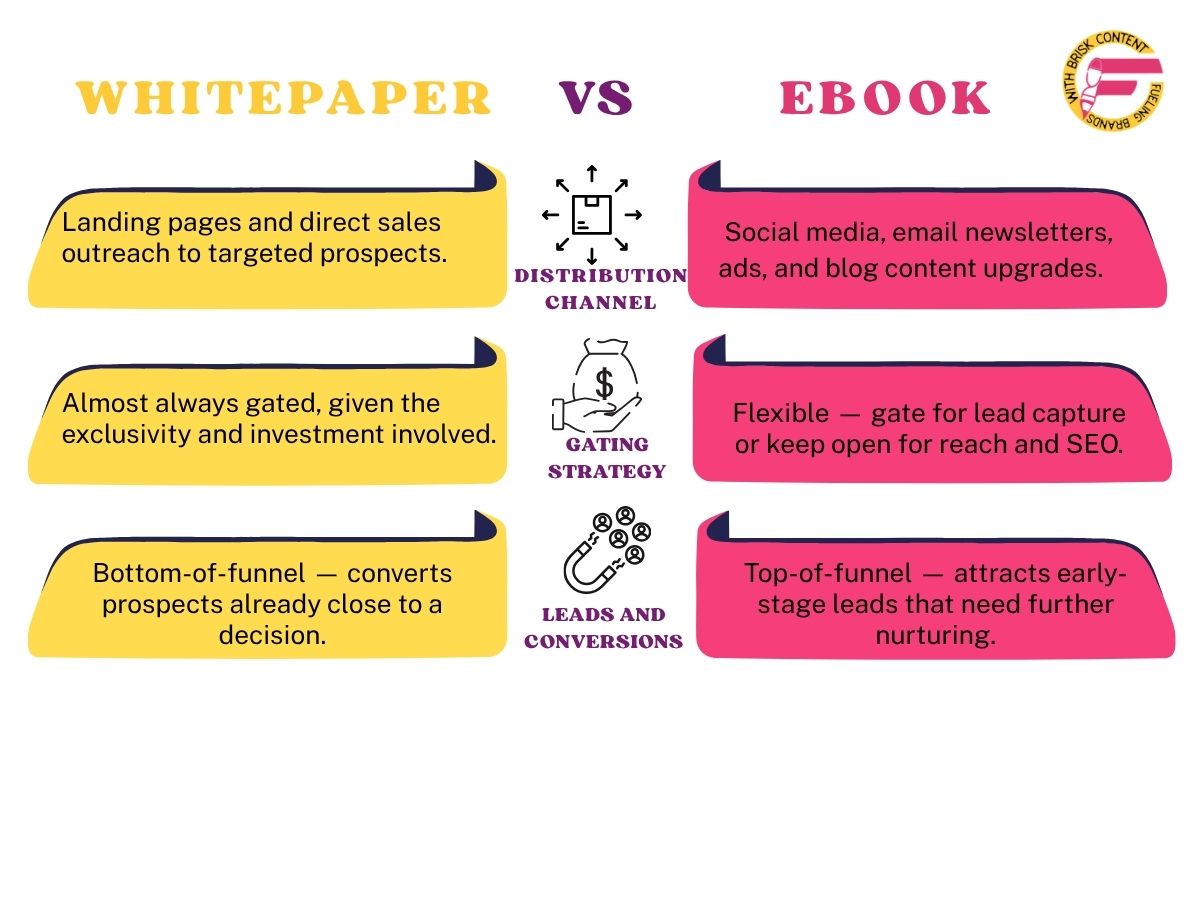
Whitepapers: You typically distribute them via dedicated landing pages. At the B2B level, they are shared by sales representatives via personal email to specific clients.
In marketing terms, a prospect who has shortlisted a few vendors downloads it to validate their decision. It can therefore be considered as a bottom-of-the-funnel content, where the buyer is very close to making a purchase decision.
eBooks: You can promote via social posts, email newsletters, paid ads, and content upgrades on blog posts. It is built for a broad reach.
For example, when someone searches “how do I build a content strategy” and lands on your free ebook, that is top-of-funnel marketing, reaching buyers who are just beginning their journey.
Gating Strategy
A decision every marketer must make before publishing either of these pieces of content is their ‘Gating Strategy.’ This means whether they require the reader to take any action to read the content. This action could be to fill out a form with their personal information or pay an access fee. Gated content may have a limited audience but higher-quality leads.
Whitepapers: As mentioned, they contain in-depth content authored by a group of experts after extensive research and analysis. Due to its exclusivity and cost, these reports are mostly gated.
eBooks: Can be gated or ungated, depending on their exclusivity and content quality. Gating it may reduce its reach, but it will be successful in generating quality leads. If the purpose is broader reach and SEO, keep it ungated.
It all boils down to Lead and Conversion.
After all, this is what the blog is about, ‘which format generates more leads?’. The answer, unfortunately, is not simple. Although both are long-form content, their intended uses differ.
eBooks cast a wide net. They attract readers just beginning to explore a topic, offering accessible, visually engaging information that draws people into your ecosystem. They are very effective lead-generating content. But the leads they bring in are early-stage buyers’ journeys and need time and nurturing before they are ready to buy.
Whitepapers, on the other hand, work at the other end of the funnel. When a person downloads your whitepaper, they already know what they need and are evaluating whether you are the best solution provider. A well-crafted white paper doesn’t just inform; it also persuades the audience through its presentation. It is the final push that moves your prospect from consideration to conversion.
To learn more about how to write effective Bottom-of-the-Funnel content, read our blog on ‘What is bottom of the funnel content and how to create it?
Conclution
Whitepapers and eBooks should not be seen as competitors but as partners in a well-rounded content strategy. So the real answer is, if your goal is to grow your audience and fill your pipeline, investing in ebooks is a good move. If you are looking to close that pipeline and convert prospects into customers, whitepapers can help you get there.
The final word is that instead of choosing between the two, the smart content strategists use both for the right audience at the right moment.
FAQ’s
Whitepapers are not exclusive to large corporations. Any business with genuine expertise and a B2B audience can leverage them. However, given the time and cost involved, small businesses should weigh whether their audience is actively seeking that depth of information before investing in one.
Not necessarily. If you have in-house subject-matter experts, they can contribute core insights. However, a professional writer or editor is strongly recommended to ensure the content meets the high standards your audience expects from this format.
Start with an ebook. It is faster to produce, less costly, and helps you build an audience before investing in the more formal whitepaper format.
No, they both serve different stages of the buyer journey, so one cannot fully replace the other. An ebook attracts and nurtures early-stage leads, while a whitepaper helps close decisions at the bottom of the funnel.
There is no fixed rule, but a practical approach is to publish ebooks more frequently, perhaps quarterly, since they are quicker to produce, and reserve whitepapers for major topics where you have strong original research and expertise to offer.
Let’s figure it out together. Book a free consultation with our team and walk away with a clear plan tailored to your audience, goals, and budget.