

17 Types of Written Content to Boost your Marketing Strategy
Content! It’s everywhere, and everyone is talking about it. In recent years, online content has emerged as the undisputed ‘King of Marketing’. Even though there are three major types of content: written content, video content, and audio content. But writers are not only responsible for written content; they are also responsible for producing video and audio content.
If people find your written work interesting, you can create a range of content and turn your gift into a source of income. This blog explores different types of content that companies create. So, read along to understand the purpose behind each type of content and its features and find out which type of content is best for you.
- SEO – GEO Writing
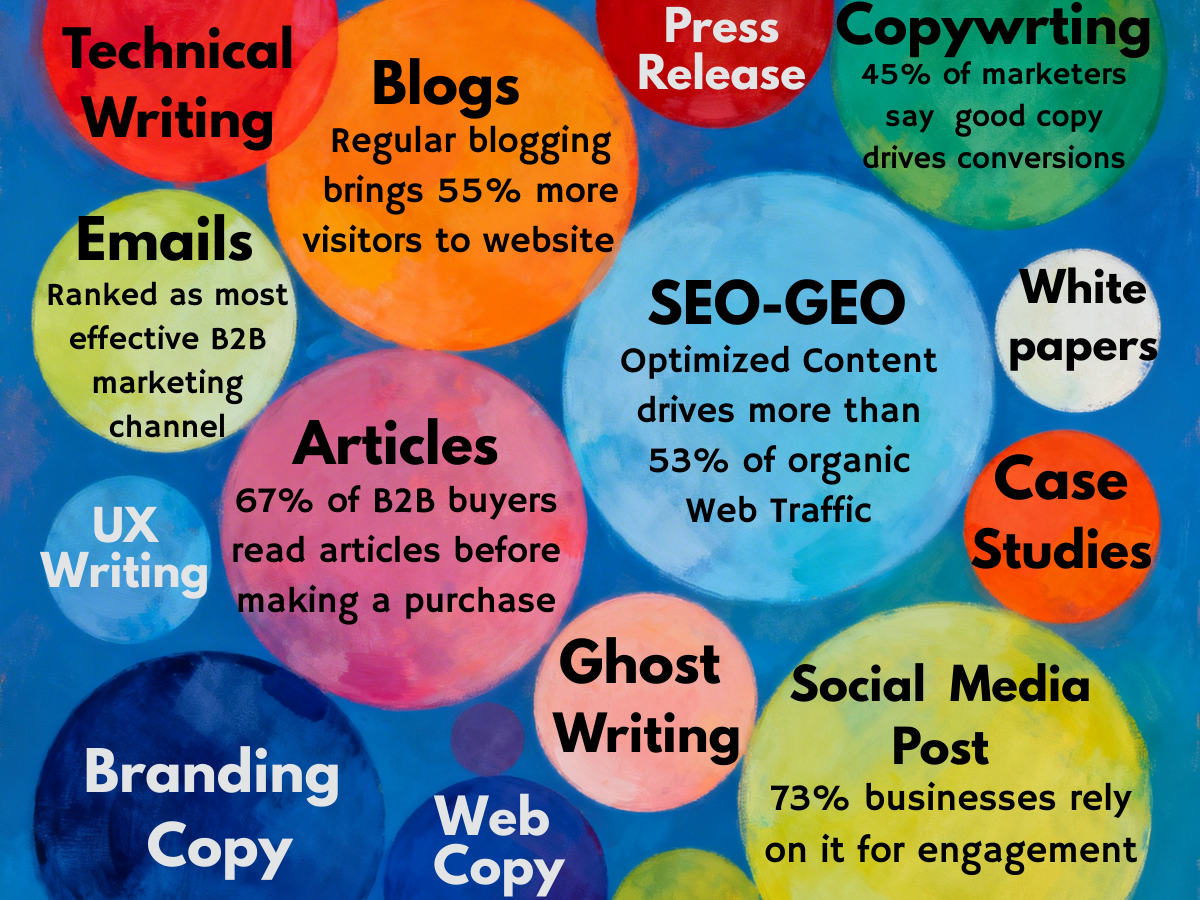
SEO (Search Engine Optimization) is a domain of content writing in which primary goal of content is to rank higher on Google search engine result pages (SERPs). The written copy integrates user-friendly information with well-researched keywords and phrases to help it rank on Google.
But more recently, the attention has shifted from SEO to GEO. What is GEO? Well! The introduction of AI into search engines has given rise to Generative Engine Optimization (GEO), where intent to rank higher in AI search engines such as Perplexity and Grok. To rank in AI search engines, content needs more than just high-ranking keywords. AI search engines check for authenticity, relevance, and up-to-date data when ranking pages. Pages that have properly referenced, unique, and recent data often rank higher. Since AI also powers Google search engines, content writers are now working on both SEO and GEO, aiming not only to rank but also to secure a spot in Google Overview.
Want to know more about GEO, our blog of ‘GEO in 2026’ is a comprehensive guide on this subject you wouldn’t want to miss.
- Blog Post
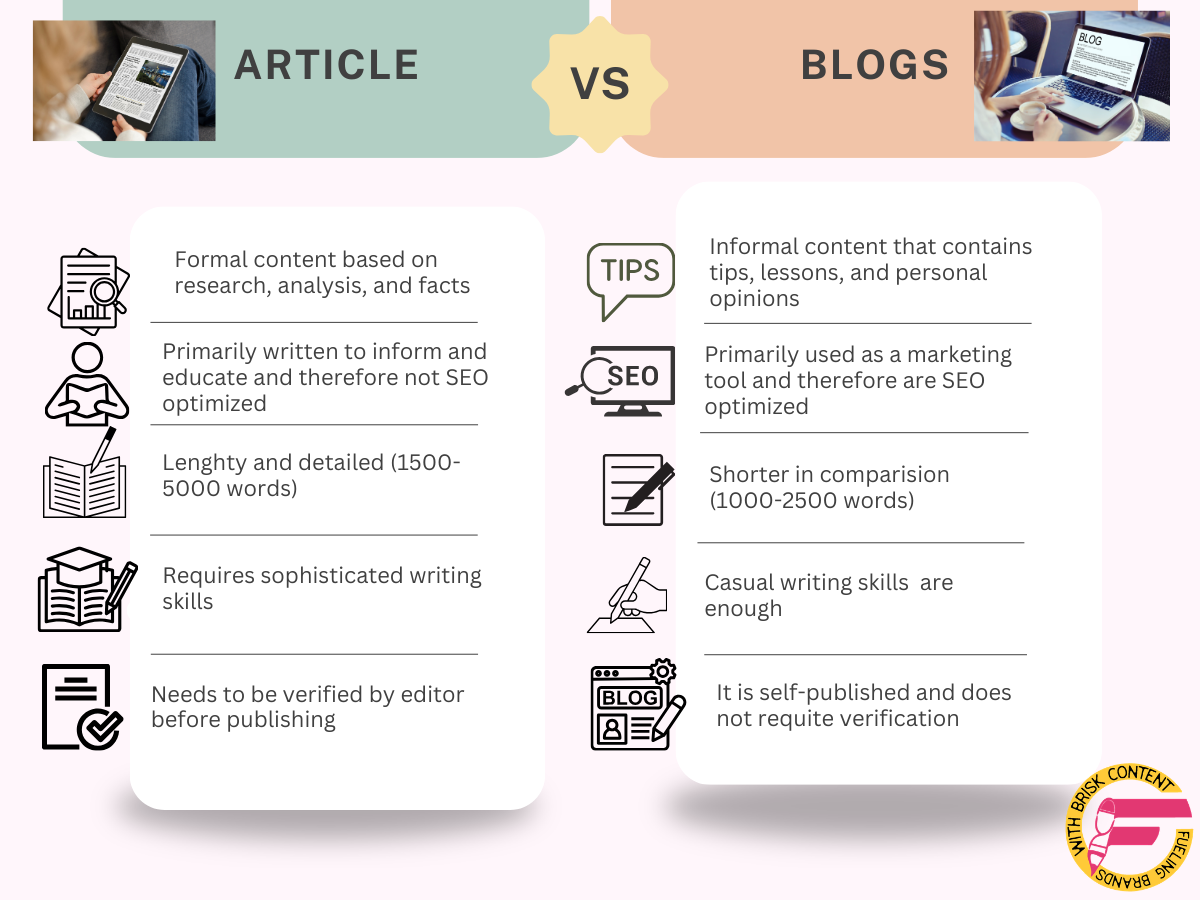
Blogs, derived from Weblogs, are creative, regularly updated content on various topics posted on websites. They written to share personal experiences, thoughts, views or expertise on multiple subjects. The two main types of blogs are:
Personal Blogs – Posted on a personal website to share travel experiences, personal views, or specific expertise. There are various types of bloggers, including food, fitness, and lifestyle bloggers. Those who believe they have a unique idea worth sharing. Furthermore, they can turn their blogs into a source of income by earning affiliate commissions from affiliate links. Examples of famous blogs include Labnol.org by Amit Agarwal, a tech blogger; YouStory by Shardha Sharma, which covers real-life startup stories; and TheShootingStar by Shivya Nath, which covers diverse travel experiences, to name just a few.
Corporate Blogs – Companies publish them to boost brand identity. A well-informed blog post can drive more visitors to the company website. Commercial bloggers optimize their blogs to improve their rankings in Google search results. Examples of corporations with strong blogs include Aster for health-related content, IBM for tech and data, and Airbnb for travel-related content, among others.
- Articles
Articles are widely used written content formats in digital and print media. They inform and educate a target audience on a specific topic. Unlike blogs, articles tend to follow a more formal structure and are long, in-depth pieces of written content, making them a more credible source of information.
They are published to establish authority in magazines, newspapers, online publications, and industry platforms. In content writing, articles are a powerful tool for building brand credibility and delivering value to readers.
- Copywriting
Copywriting is a purely commercial form of writing. The copywriters create persuasive content with sales in mind. The aim is to win customers with their clever writing. Copywriters write content for advertising campaigns, sales pitches, and tag lines. The objective is to capture the audience’s attention and convince them that your product will provide the solution they are looking for. The writing should be attention-grabbing, clear, and concise. In a few impactful words, it should convince the audience to take the intended action, such as buying, investing, subscribing, or visiting your store or website. Examples of some impactful copywriting are: ‘Because you’re worth it ’- L’Oréal, ‘Just Do It ’-Nike, ‘Daag Acche Hai ’-Surf Excel, ‘Kuch Meetha Ho Jaye ’-Dairy Milk, etc.
Click here to read more about tapping into the power of Copywriting.
- Social Media Post
The popularity of social media has pushed brands to leverage it as a marketing medium. Corporate businesses maintain accounts on social media platforms such as LinkedIn, Instagram, and X to influence their target audience online.
Content creators craft content tailored to the audience in form of trending reels, articles, posts, polls, etc. Through these platforms, companies aim to engage their audience, understand their views on products and services, and identify any unmet requirements. The audience primarily uses these platforms for entertainment; therefore, the content should be engaging enough to capture their attention while remaining meaningful and effective. Zomato, Airbnb, Dove, and Amul are examples of successful marketing campaigns.
- Branding Copy
To put it simply, branding copy gives the company its personality. It builds a distinct voice for your brand in consumers’ minds, one they will always associate with your company. Unlike copywriting that drives immediate sales, branding copy establishes what your brand stands for. Concurrently, it remains consistent across all platforms. Excellent branding copy doesn’t just describe what you do; it communicates why you exist and what makes you different. When done right, it turns customers into loyal advocates who choose your brand not just for the product, but for what it represents. Examples of a few impressive brand copies are
- Apple’s “Think Different” -The brand became synonymous with innovation and creativity.
- Amul’s “The Taste of India” – Established Amul as a homegrown, trustworthy brand deeply rooted in culture and values, which each indian can connect to.
- Tata’s “Leadership with Trust” – Communicates integrity and reliability, shaping how consumers perceive every Tata product.
- Technical Writing
The technical writers make complex technical information simple enough to be understood by a layman. They are employed by firms, such as engineering, medical, and law, to explain complex concepts to the public. Majorly, technical writers write product descriptions and how-to manuals that accompany the product. They help consumers navigate the technical details with ease. For instance, if you buy a new laptop with many features, the ‘how to set up’ or ‘steps to setup’ manual that comes with it is written by a technical writer who step-by-step guides the user, who could be anyone from a grandfather to a housewife, in a way that is easy to understand.
- Web Copy
Web copy is the writing of engaging content for web pages. Neat, clean, and formal webpages convey a sense of trustworthiness. A user-friendly and attractive web copy engages visitors, keeps them on the website, and encourages them to explore its features. The copy should also include a clear Call to Action (CTA) to boost conversions. The copy creator should keep in mind that the users can access the website on other smart devices. Engaging, easy-to-understand web page content enhances the user experience, boosts sales, and builds customer loyalty. To learn more about how to write a successful web copy, read our blog ‘Web Content Writing for Business’. Examples of well-constructed web copy include the ZARA online store, which features a clean design and high-resolution images.
Email is a trusted and efficient channel for communicating with consumers. They can be used to deliver advertisments and send newsletters. Email writers should include a hook in the subject line, make the message as personalized as possible, and include a clear call to action. A professional should sign off on them to confirm the sender’s identity (rather than just adding the company name; include the name of the marketing or HR manager). Content writers must also craft an email newsletter, a powerful tool for fostering customer loyalty and positioning the brand as an industry leader.
- Academic Content Writing
As the name suggest academic content writing is related to education. Academic content shares knowledge through carefully researched material backed by formal evidence and appropriate citations. It is detailed and is created only for a specific audience. Research papers, textbooks, and theses are all examples of academic content.
- Case studies
Case studies strengthens customer loyalty and trust. They are in‑depth reports that describe how a business succeeded or failed in serving a particular client. It often highlights how their product, service, or solution addressed their customers’ requirements or failed to do so and what they learned in the process.
- Whitepapers
White papers are detailed and influential reports on a company’s products, services, or topics related to its field of expertise. The goal is to subtly persuade consumers by addressing a need and proposing a viable solution. It is supported by original research and analysis done by the author. White papers were initially issued only by government bodies, but more recently, they have been used as a B2B marketing strategy.
Companies build credibility by demonstrating deep industry expertise through whitepapers. This, in turn, leads to customer trust and a competitive edge in the market.
- Press Release
When a corporation wants to make an important announcement to the public, they do so through the media. These announcment are known as a Press Releases. The company issues a press release to announce a product launch, an event, a milestone, financial results, new partnerships, awards, or recognition, etc. Companies promote brand awareness and enhance the company’s public image through it. The press release features a catchy, concise yet informative headline: “Tata Motos Unveils New Electric SUV targeting Mid-Range Segment.” or “ITC Earns Highest Global Recognition for Water Stewardship”. When we read these headlines, it becomes very clear what the press release is about.
- Ghost Writing
When famous personalities want to write a book on a topic but lack the time or skill to do so, they hire a ghostwriter. A ghostwriter writes a book for someone else but does not take credit for it. The book could be about the writer themselves, like an autobiography or something they want to share with the world. The writer must clearly understand the writer’s thought process and context. Famous sports, business, or political personalities hire them to enhance their public image and establish themselves as leaders in their fields.
- Video Script Writing
Short-form videos are the most popular format for sharing content online, especially on platforms like TikTok and Instagram. Script is the soul of the video. A good script is entertaining and engaging, with a strong call to action. Video scriptwriters not only write dialogue but also include details about on-screen actions and visual cues to accompany it, making the content attention-grabbing and engaging.
- Presentations
Writing content for presentation slides is also a form of content writing. Content writers must clearly understand the presentation’s topic and purpose. The slides should highlight only the key points and be concise. Visually appealing elements, such as images, infographics, and videos, are added to slides to make them engaging and help maintain audience attention through to the end.
- UX Writer
User Experience (UX) refers to a product’s usability. It primarily describes how well-designed the digital products, such as websites and apps, are in terms of ease of use. UX writers create content for these digital products to help users operate them with ease, including titles, labels, image labels, and error messages. The UX team is responsible for making the digital products user-friendly and easy to navigate.
Conclusion
The content writing industry offers multiple prospects for skilled writers. Whether you’re drawn to expressive blogging or persuasive copywriting, there’s a niche for every writer.
Although AI has made content creation faster and easier, demand for skilled content writers is growing because AI-generated content lacks the essential emotional touch only a human can provide.
You can start by exploring the types of content that resonate with you and build your portfolio. Many successful writers combine multiple content types to create diverse income streams.
FAQ’s
SEO (Search Engine Optimization) focuses on improving rankings in traditional search engines only through keyword optimization. Whereas, GEO (Generative Engine Optimization) is used for AI-powered search engines such as Perplexity and Grok, and, along with keyword optimization, it requires that the content be authentic, well-referenced, and up-to-date. Modern content writers now work on both to maximize visibility across all search platforms.
Typically, copywriting and technical writing roles command higher pay because of their direct impact on sales and user experience. However, ghostwriters for high-profile clients and white paper creators can also command premium rates for their services. How much you will earn depends on your expertise and client base.
Absolutely! Many successful content writers combine multiple content types to diversify their income streams. For example, you might write blog posts and social media content for one client while creating email newsletters for another.
Yes, a few specialised types of content writing require specific skills. For example, copywriting requires persuasive skills, and technical writing demands the ability to simplify complex data, etc.
Consider your interests, strengths, and career goals. If you enjoy research and education, academic or technical writing might suit you. If you’re creative and persuasive, try copywriting or branding. Start by experimenting with different types, and analyze what you enjoy and are interested in. Monitor evolving market needs and upskill accordingly to stay competitive.