

How to Create a Powerful Brand Voice for Your Business
You can have a great product, a sleek logo, and a clever tagline and still lose a customer to a competitor. When it is hard to find out why a customer chooses a similar product from a different brand despite competitive marketing and pricing, in most cases, that’s a powerful brand voice at work.
This article explores the secret of creating a powerful brand voice for your business that drives sales and builds long-lasting loyalty.
What Is a Brand Voice?
Brand voice is the deliberate effort to make a company feel like a person with a point of view, a set of values, and a distinct way of communicating.
Brand personality is built from human traits such as health-conscious, adventurous, carefree, humorous, caring, luxurious or rebellious. These traits are chosen to mirror the personality of the customer the brand wants to attract.
Think about Thums Up versus Limca. Both are cola-category beverages, both owned by the same parent company, yet they speak to completely different people. Thums Up advertising is all adrenaline aimed at people who see themselves as bold risk-takers. Limca, on the other hand, is calm and easy. Two brand voices, two entirely different emotional vibes. That is the power of a well-defined brand voice.
People do not connect with products. Instead, they connect, trust, and stay loyal to the brand’s voice or personality.

How Brand Voice Helps Drive Sales and Customer Loyalty
Most brand-voice articles discuss how to differentiate the brand through its voice. But the one question that actually matters in business is, does it drive sales?
The answer is yes, but not in the way discounts or special offers do. Brand voice works on a slower, deeper level to make an emotional connection that heavily influences the buying decision.
Studies show consistent brand voice can increase revenue by 23% to 33%, and many companies report double-digit revenue gains after improving consistency.
When two products are virtually identical in quality and price, the customer will choose the brand they feel emotionally aligned with. A well-executed brand voice makes the customer feel, “This brand reflects my values and my attitude towards the world.”
Amul has built one of India’s most loved brand voices through its iconic ‘Amul Girl’. It’s ads on billboards and in newspapers that are witty, warm, and Indian. That voice has kept Amul relevant across generations and built trust that is hard to compete with.
When you have made space in a customer’s heart by connecting emotionally, competitors find it very difficult to steal that customer on price alone. Consistency in voice, paired with consistency in quality, builds trust that is hard to compete with.

5 Actionable Steps to Create a Brand Voice
So let’s answer the big question: how do we actually build a brand voice that will bind customers to your brand forever?
1. Define Your Core Brand Personality Traits
Start by choosing three to five human personality traits that your brand will embody. Ask yourself: if my brand walked into a room, how would it speak, dress, and treat people? For instance, “Professional” is too vague; instead, “Warmly authoritative, like a trusted family doctor” is a brand voice.
2. Understand Your Audience Deeply
Your brand voice must mirror your ideal customer’s values and self-image. Perform an intense research on who they are, not just demographically, but psychologically. Find out what their values are. What kind of humor do they like? And what are their pain points?
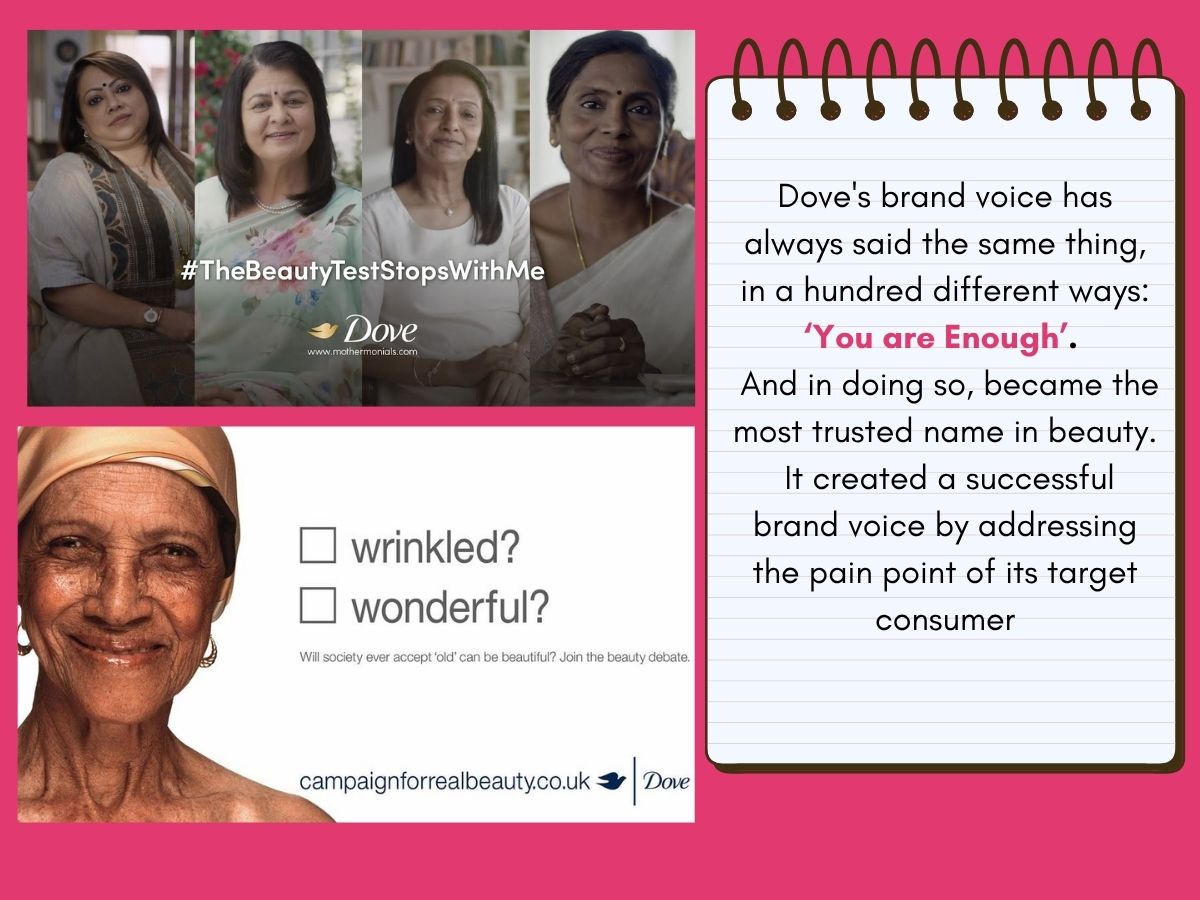
Dove’s “Real Beauty” campaign succeeded globally because it spoke directly to the insecurities and aspirations of real women. The voice was empathetic yet honest and bold. Most importantly, it reflected what the modern woman (their target audience) believed and felt.
3. Choose Your Spokesperson Strategically
One of the fastest ways to build a brand voice is to attach it to a human personality that already represents it. When Lux roped in Kareena Kapoor, it was not just because of her fame; it was tapping her aura of glamour, confidence, and luxury and transferring it onto the brand. Her fans and admirers naturally began associating those qualities with Lux. There is a vast difference between merely endorsing a brand and becoming an inseparable part of it, as Kohli and Dhoni are for RCB and CSK.
4. Let Your Voice Live in Your Events and Actions
Ask yourself what events, causes, or communities your brand should be visibly part of. Make your visibility felt in places and events your target audience attends.
You can go one step further by hosting events entirely of your own. For instance, Nykaa’s Women of Worth initiatives celebrate women entrepreneurs in the beauty and wellness space. For Nykaa, a brand founded by a woman and built largely on women’s ambitions, these events are proof of its brand voice: women supporting women.
5. Document Your Brand Voice
Create a Brand Voice Guide for your brand. This guide should be a clear document that includes your brand’s personality traits, explanations, tone across different situations (social media, customer service, advertising), the types of words to use and those to avoid, and real examples of your voice done right. This document should be mandatory reading for every new writer, designer, and marketer who joins your team.
How to Maintain a Consistent Brand Voice
Consistency is as important as building a brand voice, because only when you are consistent will you be able to make a place in customers’ hearts and minds. Here is a framework to follow to keep your brand voice consistent:
Audit brand messaging regularly: Every quarter, review your content across all channels, such as social media, packaging, ads and emails and ask whether it all sounds like the same brand. Inconsistency hurts the impact of the brand voice.
Train your team, not just your agency: Your customer service executive and your social media intern both represent your brand voice. Invest in training teams thoroughly across all sectors. Briefing just your ad agency once a year is not enough.
Evolve without abandoning: A brand voice should remain consistent but can mature over time. Cadbury Dairy Milk India advertisement created by Late Piyush Pandey is a masterclass in deliberate voice evolution. It began its campaign as a children’s brand, which was sweet, innocent and celebratory. Then came the iconic 1990s “Real Taste of Life” drive with a girl dancing on a cricket field. This heartwarming ad deliberately shifted the voice toward carefree, spontaneous joy for young adults. Over the next two decades, it deepened further into warmth and togetherness with “Kuch Meetha Ho Jaaye,” positioning chocolate as the way to celebrate happy moments. Each evolution expanded the target audience without abandoning the emotional core: ‘celebration through sweetness’.
Listen to your customers. Your audience will tell you when your voice rings true and when it feels fake. Customer feedback in the form of reviews, comments, and direct conversations is the most honest brand audit you will ever get. The brands that last are the ones that keep listening and evolving.
Conclusion
Building a powerful brand voice with a lasting impact is about deciding, with clarity and conviction, who your brand is and then living that identity out loud, consistently, across every touchpoint. The brands that do this well do not just attract customers; they build loyalty, which is the most sought-after competitive advantage in business.
You do not need a massive budget to build a powerful brand voice. You just need clarity and courage to show up the same way every single time — on every platform, in every post, and through every customer interaction.
Maintaining an effective brand voice is all about being in control of what it says and saying it consistently enough to be remembered.
FAQ’s
There is no fixed timeline, but most brands begin to see recognizable traction between 12 and 18 months of consistent, deliberate effort across all touchpoints.
Brand voice is arguably more important for small businesses than large ones. A startup cannot compete on advertising budgets, but it absolutely can compete on personality, warmth, and relatability. In fact, many small Indian D2C brands like Boat and Mamaearth built fierce customer loyalty through a clearly defined brand voice long before they had the budgets to match larger competitors.
Brand voice is your brand’s consistent personality, which does not change. Brand tone is how that personality adapts to different situations. For example, Amul’s brand voice is always witty and warm, but its tone on a lighthearted topical billboard is playful. In contrast, its tone in response to more serious political issues would be warmer and more empathetic.